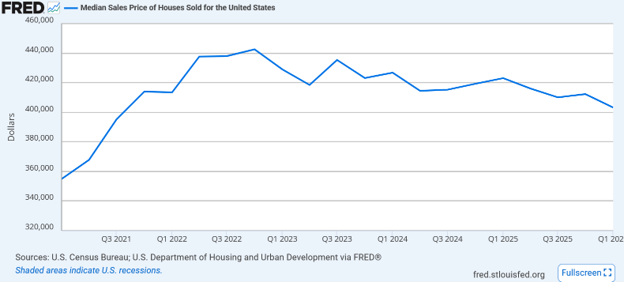
The consensus among major economists is that there will be a slight reset in house prices primarily due to higher interest rates. We are already seeing this with the median home price (chart above). Even with rates staying high, are the economists wrong and will we actually see rising prices in 2027 and beyond? Take a look at the one chart below which is why I am now convinced that the economists are wrong.
Consensus is that rising rates will lead to lower home prices
The consensus amongst most major economists is that housing prices will fall in many markets or best-case scenario stay about constant. This is already reflected in the data. As you can see in the chart above, from the Federal Reserve report on Median house prices, there is already a decline underway. This leads to the question, will the trend of declining median house prices continue/accelerate, or will this trend bottom out and ultimately reverse?
Are interest rates the primary driver of home prices?
Over the last 15 years or so, there is no doubt that interest rates were the biggest driver of home prices. Basically the government subsidized higher and higher home prices by reducing mortgage rates which increased everyone’s ability to buy a house.
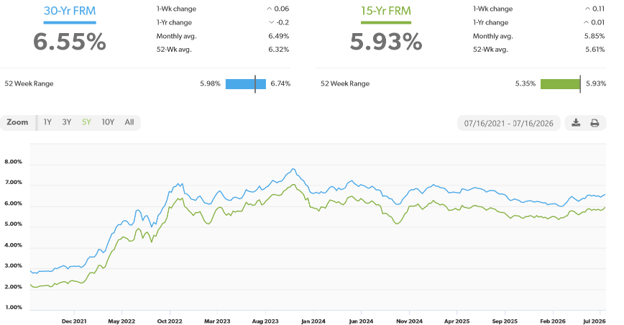
For example, take a million dollar home. If you bought this 5 years ago when rates were around 3%, the payment would be 4216/month. Fast forward to today and based on a rate closer to 6.5%, the payment would be 6,320/month.
So even with a lower salary you could afford a much more expensive house. This clearly drove up house prices throughout the country leading to a buying frenzy that peaked around 2022. Look at the chart above from Freddie Mac. This trend has quickly reversed with rates continuing to hover north of 6% with no end in sight to the higher rates.
Real driver of home prices is supply and demand
Although artificially low interest rates over the last 15 years inflated home prices, historically the drivers of prices are supply and demand. For example, in the famous ski town of Aspen, CO demand greatly outpaces supply which has led to rising prices. Similar analogies can be made for almost any desirable market. So in order to understand where house prices head from here we need to not only look at interest rates but also the drivers of supply and demand. There are some huge factors that are going to greatly influence both factors over the coming years.
3 factors that will greatly reduce supply
- Rising interest rates: Rising rates will reduce supply two ways:
- People not moving/downsizing: anyone who has an ultralow rate will likely not move unless they are forced to. I think of myself, I locked in a rate at 2.75%, there is no incentive to move when you factor in the higher payment on another property along with the capital gains from the huge appreciation over the last 15 years.
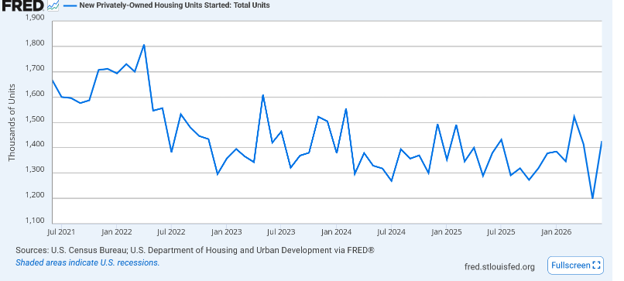
- Building slows down: Look at the chart below of housing starts, they are down over 22%, with one of the primary reasons higher rates makes building more expensive to finance and general nervousness about the demand as a result of higher rates
- Road to housing act targeting investors: we have not seen it yet, but the new road to housing act drastically increases the risk to corporate investors of housing by limiting the number of houses and opening corporations to increased rules/requirements that will basically end wall street investment in housing. The elimination of Wall Street will further reduce supply.
- Local governmental regulations like rent control, eviction moratoriums: Unfortunately local governments are also inadvertently reducing supply. Look at places like NY that continue to place restrictions on property owners with rent control. From an investment perspective these markets are no longer worth investing in which will further reduce supply. We have seen this play out in cities like Denver and international cities like London. Ultimately the onerous government regulations reduce supply.
What happens to housing demand?
Although the chart below is an old chart, the premise still holds that supply (noted above) is not keeping pace with demand for housing. This is the general consensus in the industry that we have grossly underbuilt housing. I would clarify on this statement that we have underbuilt housing in desirable markets. For example, there is plenty of housing in Detroit or many of the old rust belt cities in Ohio, but in places like Austin Texas, there is a big undersupply.
To put some numbers to above, in Pueblo, CO a few hours south of Denver the median home price is around 250k. On the flip side Denver’s median home price is closer to 700k. The difference is attributed to demand. There is a much greater demand for housing in Denver due to jobs, economic vitality, desirability of amenities, etc.. so Denver follows the chart below, but on the flip side there is no shortage of houses in Pueblo.
With that said, if you look at the entire country regardless of interest rates demand still outpaces supply overall due to the mismatch in desirable markets.

How does the supply and demand dynamics ultimately increase house prices
It is important to note that we will have a reset in prices over the next 1-3 years with some markets declining as much as 20%. With that said, the decline should be relatively short.
To understand what happens in the future we need to look at rents as an indicator. In the short-term rents have declined due to oversaturation, especially at the high end. This trend will quickly reverse due to government policies and high interest rates.
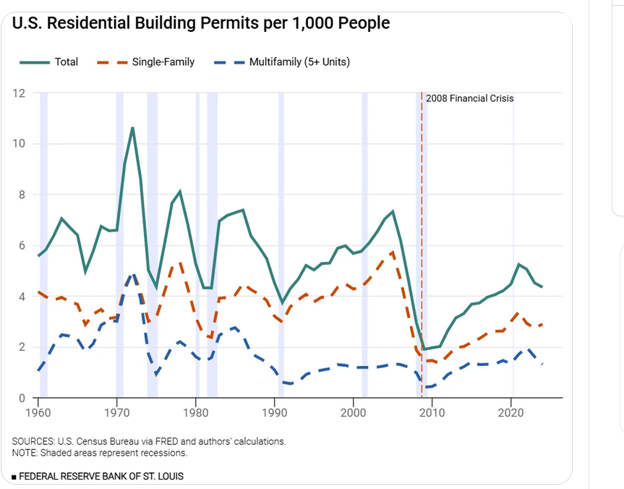
Looking at the chart above, housing supply built annually has declined 65% since the peak in 2007 and continues to trend downward. As a result of the trending down of supply even if demand decreases a bit due to higher interest rates there will still be a shortage of houses. This mismatch of supply and demand especially in desirable markets will only lead to one thing, higher rents.
Higher rents will lead to higher prices
This cycle will be different than prior cycles as typically higher rents would lead to increased supply, this will not occur as it has historically as build costs are considerably higher, government regulations are much more onerous, and a large source of buiders backed by Wall Street will sit on the sidelines. On a side note, you will see small-time investors get back or increase their activity in the rental market, but it will not be enough to overcome the huge supply deficiency.
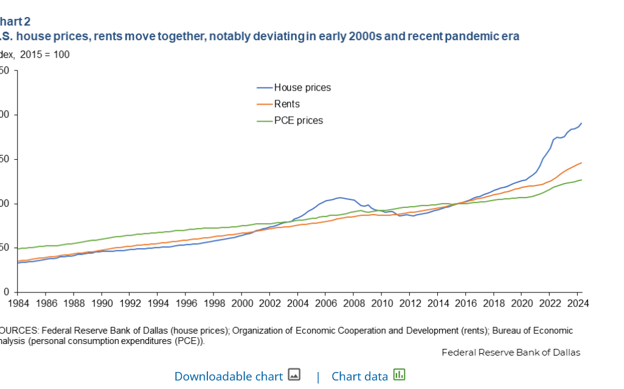
We have seen in almost every cycle that Higher rents ultimately lead to higher prices. See the chart below from the federal reserve demonstrating this correlation. This is how the federal reserve bank explained the correlation:
U.S. house prices and rents are generally closely aligned, with only two significant deviations since 1984—in the early 2000s and following the pandemic. The rent index is fairly smooth and closely tracks the personal consumption expenditures (PCE) price index, with rents growing a little faster than overall inflation (Chart 2). Divergence between house prices and rents in the early 2000s and again in the recent period followed a significant increase in real (inflation-adjusted) house prices and stable real rents.
Long term prices will rise in desirable markets
Although economists and I have been sounding warning bells about a house price reset, it is important to note that this reset will be temporary. Long term trends of reduced supply, stable demand, and rising rent prices will ultimately lead to increasing house prices. I’m convinced that house prices will rise over the long term, but we all know real estate is local so the real answer is that house prices will rise in “desirable” markets. The million-dollar question is what markets will be the “desirable” markets in five years? I’ll discuss this topic in another blog post, in the interim, you can rest assured that long term your real estate investment will be great in good markets.
Additional Reading/Resources
- https://www.freddiemac.com/pmms?gad_source=1&gad_campaignid=23396332682&gclid=EAIaIQobChMI2MTJzunolQMVTB2tBh3OpR3WEAAYASAAEgJvyPD_BwE
- https://fred.stlouisfed.org/series/MSPUS
- https://fred.stlouisfed.org/series/HOUST
- https://www.urban.org/urban-wire/housing-supply-falls-short-demand-430000-units
- https://business.columbia.edu/press-release/cbs-press-releases/higher-rates-higher-rents-how-monetary-policy-affects-housing
- https://www.dallasfed.org/research/economics/2025/0225
- https://www.fairviewlending.com/what-happens-to-mortgage-rates-the-rest-of-the-year/
- https://www.fairviewlending.com/will-real-estate-fall-to-covid-levels-the-results-will-surprise/
- https://www.fairviewlending.com/what-does-may-inflation-mean-for-interest-rates-and-real-estate/
We are a Private/ Hard Money Lender funding in cash!
If you were forwarded this message, please subscribe to our newsletter
Glen Weinberg personally writes these weekly real estate blogs based on his real estate experience as a lender and property owner. I’m not an armchair reporter/writer. We are an actual private lender, lending our own money. We service our own loans and own commercial and residential real estate throughout the country.
My day job is and continues to be private real estate lending/ hard money lending which enables me to have a unique perspective on the market. I don’t accept any paid sponsorships or ads on my blog to ensure accurate information. I’ve been writing this for almost 20 years and have over 30k subscribers. Please like and share my blogs on linkedin, twitter, facebook, and other social media and forward to your friends 😊. I would greatly appreciate it.
Fairview is a hard money lender specializing in private money loans / non-bank real estate loans in Georgia, Colorado, and Florida. We are recognized in the industry as the leader in hard money lending/ Private Lending with no upfront fees or any other games. We fund our own loans and provide honest answers quickly. Learn more about Hard Money Lending through our free Hard Money Guide. To get started on a loan all we need is our simple one page application (no upfront fees or other games). Learn how to find a reputable hard money lender and why Fairview is the best hard money lender for investors.
Written by Glen Weinberg, COO/ VP Fairview Commercial Lending. Glen has been published as an expert in hard money lending, real estate valuation, financing, and various other real estate topics in Bloomberg, Businessweek ,the Colorado Real Estate Journal, National Association of Realtors Magazine, The Real Deal real estate news, the CO Biz Magazine, The Denver Post, The Scotsman mortgage broker guide, Mortgage Professional America and various other national publications.
Tags: Hard Money Lender, Private lender, Denver hard money, Georgia hard money, Colorado hard money, Atlanta hard money, Florida hard money, Colorado private lender, Georgia private lender, Private real estate loans, Hard money loans, Private real estate mortgage, Hard money mortgage lender, residential hard money loans, commercial hard money loans, private mortgage lender, private real estate lender, residential hard money lender, commercial hard money lender, No doc real estate lender