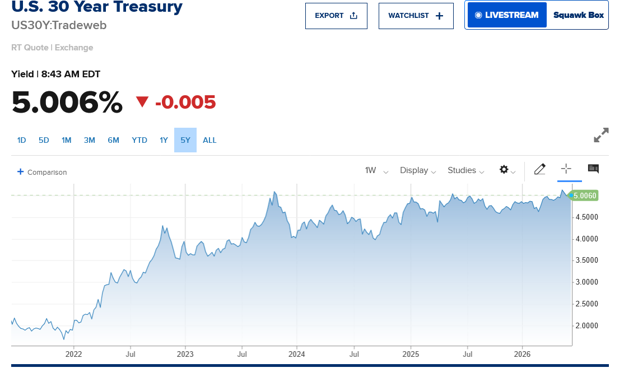
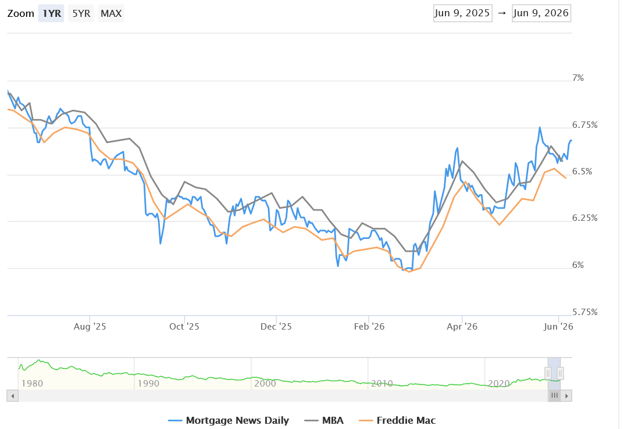
The May inflation report is in, rising to the highest level in 3 years. Look at the chart above, out of nowhere yields have surged to almost 20-year highs and predictions exceeding 6%. The market is suddenly catching on that we have an inflation problem. Take a look at the chart below, why are these charts rising together? Does this give the federal reserve permission to raise rates? Is the real estate market at an inflection point? Is the May inflation just a blip or is something larger happening in the economy?
Why are longer term treasury rates rising so quickly?
Global bond yields have surged in recent weeks as a jump in energy prices caused by the Iran war adds to inflationary pressures and compels central banks such as the Fed to consider raising interest rates. Along with higher inflation, the jobs market seems to be stabilizing which is limiting the downside risk. Add in worries over US budget deficits and signs that the world’s largest economy remains resilient, and the result is that investors have been seeking greater compensation to own longer-maturity debt which is leading to much higher longer term rates. Remember the more debt there is, the more debt has to be sold to the market. As the supply of debt increases bond prices decline due to less demand (remember bond prices and yields work in the inverse so lower bond prices lead to higher yields/interest rates)

Is this surge in rates a blip or a trend?
The million-dollar question is what happens next with rates. Will inflation quickly abate after the energy shock or has something else happened in the economy? There are two schools of thought on what happens next.
- Inflation is a blip: the market is currently pricing in a goldilocks scenario where inflation rapidly decreases due to a resolution of the energy crisis. We are seeing this as stocks continue to power higher in light of rising rates. This theory is quickly being challenged as inflation, the job market, and government spending continue to power higher. Furthermore, it is much harder to now factor in every even as a one off from the war in Iran to higher food costs to higher labor costs.
- Bigger structural economic changes lead to higher inflation: The bond market is pricing in the polar opposite scenario as we can see from the surging long term bond yields. The theory is that the economy is doing much better than expected while at the same time surging governmental debt is creating a structural issue with substantially higher rates for longer due to more supply of bonds. Look at the chart above of the surging national debt throughout the world. If you line up the chart of 30 year yields with the surge in government debt, they are uncannily similar.
Why care about bond yields when valuing real estate?
Economics is based on opportunity costs. You could buy X or Y and get a return for each asset, so it is a balance of risk and reward for investors. For example, you could buy a government bond at 5.5% with basically zero risk or you could buy a commercial piece of real estate. Essentially as bond yields increase returns on other assets like commercial real estate must rise to compensate for the same risk of inflation. This return on investment in real estate is known as the capitalization rate (more details below) A good example would be a retail location that might have traded at a 4% cap rate in 2020 when yields were around 2%, the cap rate would now need to be about 2% higher than treasuries for the increased inflation risk which puts the cap rate around 6-6.5%.
What is the capitalization rate?
The capitalization rate (also known as cap rate) is used in the world of commercial real estate to indicate the rate of return that is expected to be generated on a real estate investment property. This measure is computed based on the net income which the property is expected to generate and is calculated by dividing net operating income by property asset value and is expressed as a percentage. It is used to estimate the investor’s potential return on their investment in the real estate market. In essence the cap rate is a measure of the “riskiness” of a property. A higher cap rate would deem a property riskier, and a lower cap rate would mean the property is low risk.
Furthermore, the Capitalization can also be considered the “trade off” rate for various assets.
How does the Capitalization rate impact commercial real estate values
To value commercial real estate, you can look at what comparable properties are selling for and also calculate the net operating income to determine the value. The income approach is critical to the valuation of a property. The basic calculation is Net Operating income (revenues-expenses and excludes mortgage/interest payments). The NOI is then divided by the capitalization rate to determine the value. For a basic example, let’s assume a properties NOI was 100k/year and that the property was a high-quality property so the cap rate was 5%, so the value is 2m.
Huge changes in commercial real estate values due to rising yields
There are two primary variables impacting value of commercial properties, the net operating income from the property, and the expected return on the property (cap rate).
- NOI: the income on many properties is declining substantially due to the virus. For example, the lease rates on office space are plummeting due to lack of demand, furthermore existing office users are negotiating lower rent rates to continue their lease. On top of this vacancy rates are ticking up as companies close or substantially scale back. Furthermore, NOI is getting compressed due to higher inflation increasing the costs of just about everything from insurance, materials, labor, utilities, etc…
- Cap rates: Cap rates are surging as properties that were once deemed “safe” are now very risky, for example a restaurant in a great location might have traded on a 4 cap, now that property might trade on a 7 or 8 cap due to the uncertainty in the industry
What does the surging yield mean for commercial real estate values/defaults
There is going to be more pain ahead in commercial real estate. As rates continue to rise along with cap rates values will have to adjust. Furthermore, many properties with higher cap rates and lower net operating incomes will not make sense except at greatly reduced prices.
On the flip side excellent properties with great tenants will still be in demand, albeit at higher cap rates than today. The theory is that hard assets like real estate can act as a hedge against inflation as rents can be adjusted to compensate for the increased inflation.
Residential real estate values will also be impacted from rising rates
Although residential real estate is not typically valued using the capitalization rate there is a huge correlation between rents, rate of return, and the ultimate value of residential real estate. As a result, residential real estate will be impacted as well. Take a look at the chart above of the 30 year mortgage rate there is a huge surge.
Due to the higher rates, we will see the pullback first in large funds focusing on rentals that are already slowing down purchases in the residential market as interest rates rise, costs rise, and income falls. From a true investment perspective many residential real estate properties no longer make sense for funds as the returns are below what you could get in a risk-free asset like a government bond.
Furthermore, with rising rates, look for sales volumes to remain anemic going forward as higher rates continue to price many out of the market and others just sit tight in their low interest rate mortgage.
On the flip side, residential will be a bit more insulated than commercial property because most residential mortgages are long term fixed loans (30 years) so there is not a constant need to refinance and if someone can’t sell their home, more often than not, they have the option to just sit tight.
Where do we go from here in regard to prices and interest rates?
The market has so far misinterpreted the extent of inflationary pressures coupled with increased government spending which is leading to the dangerous economic cocktail we are seeing today. Based on the recent CPI numbers and strength of the labor market, we can’t dismiss the rise in inflation just as one off events anymore. In turn, the commercial real estate market and to some extent the residential market is in for a tough ride in 2026 and beyond as net income is reduced and cap rates are increased. This is just the beginning as there is considerable uncertainty as to how deep the income losses will be when leases come up for renewal and how substantial the cap rate increases will be due to higher long term rates.
Higher rates also bring to light another interesting question: will the higher interest rates cause the economy to suddenly flip into a downturn/recession (Please take the survey to the right of this blog and let me know your thoughts). Although based on the current data this does not look likely, the odds are increasing every day. As inflation remains higher interest rates will have to continue to move higher which will ultimately result in more defaults on debt from credit cards to auto loans to business loans all of which we are seeing today. With the highest debt loads in the economy we have seen in a long time the risk of higher rates setting off a broader correction is amplified.
Regardless of how this all shakes out there is more downside risk than upside heading into the second half of 2026. Look for rates to remain substantially higher than the market is pricing in for quite some time. With that said, there might be some buying opportunities later this year and into next year as the market digests the new realities of higher interest rates.
Additional Reading/Resources:
- https://www.bloomberg.com/news/articles/2026-05-19/us-yields-flirting-with-2007-highs-entice-and-divide-investors?
- https://www.wsj.com/articles/see-how-the-global-government-debt-binge-is-rippling-through-markets-cb9ce3ca
- https://www.fairviewlending.com/cap-rates-increase-impact-on-real-estate/
- https://www.fairviewlending.com/what-the-latest-inflation-upsurge-means-for-the-mortgage-market/
- https://www.fairviewlending.com/is-stagflation-dead-what-happens-now/
We are a Private/ Hard Money Lender funding in cash!
If you were forwarded this message, please subscribe to our newsletter
Glen Weinberg personally writes these weekly real estate blogs based on his real estate experience as a lender and property owner. I’m not an armchair reporter/writer. We are an actual private lender, lending our own money. We service our own loans and own commercial and residential real estate throughout the country.
My day job is and continues to be private real estate lending/ hard money lending which enables me to have a unique perspective on the market. I don’t accept any paid sponsorships or ads on my blog to ensure accurate information. I’ve been writing this for almost 20 years and have over 30k subscribers. Please like and share my blogs on linkedin, twitter, facebook, and other social media and forward to your friends 😊. I would greatly appreciate it.
Fairview is a hard money lender specializing in private money loans / non-bank real estate loans in Georgia, Colorado, and Florida. We are recognized in the industry as the leader in hard money lending/ Private Lending with no upfront fees or any other games. We fund our own loans and provide honest answers quickly. Learn more about Hard Money Lending through our free Hard Money Guide. To get started on a loan all we need is our simple one page application (no upfront fees or other games). Learn how to find a reputable hard money lender and why Fairview is the best hard money lender for investors.
Written by Glen Weinberg, COO/ VP Fairview Commercial Lending. Glen has been published as an expert in hard money lending, real estate valuation, financing, and various other real estate topics in Bloomberg, Businessweek ,the Colorado Real Estate Journal, National Association of Realtors Magazine, The Real Deal real estate news, the CO Biz Magazine, The Denver Post, The Scotsman mortgage broker guide, Mortgage Professional America and various other national publications.
Tags: Hard Money Lender, Private lender, Denver hard money, Georgia hard money, Colorado hard money, Atlanta hard money, Florida hard money, Colorado private lender, Georgia private lender, Private real estate loans, Hard money loans, Private real estate mortgage, Hard money mortgage lender, residential hard money loans, commercial hard money loans, private mortgage lender, private real estate lender, residential hard money lender, commercial hard money lender, No doc real estate lender