Once again, forecasts for inflation have bombed with the September inflation reports exceeding most forecasts. Why does inflation continue running hotter than anticipated? What does this mean for interest rates and real estate? What happens when interest rates finally “bite” into the economy? What does this mean for the risk of recession and real estate prices?
What was in the recent inflation data?
The media and fed keep harping on the idea that inflation will naturally subside as interest rates remain high, unfortunately this is not happening. The recent September data paints the opposite picture:
- US core inflation advances 0.3% in September, more than expected
- Core inflation up 2.6% on annual basis, also beating forecasts
- Traders are now pricing a greater than 50% chance for an October rate hike
- Real wages decline, keeping affordability top of mind ahead of midterm elections
- On top of the rise in consumer prices, the producer price index (PPI) also rose the most in 4 years.
Note, this is not just a US problem, all major economies throughout the world are experiencing similar inflation pains as the economy adjusts to the new normal of higher prices on just about everything. It is important to note, that inflation is not just driven by oil prices as they are a much smaller input into the economy as they were historically.
Here is a good summary of inflation today: This inflation report is flashing red for the Fed. Energy pushed the headline number higher, as expected, but the real problem is that core inflation remains stuck above 3%. Higher energy costs are beginning to seep into broader services prices, increasing the risk that this inflation burst will persist. A rate hike at the end of the month is now firmly on the table, but December remains the more likely move.
Why does inflation continue to run “hot”?
I’m amazed that the federal reserve and others continue the myth that inflation will magically disappear. Have any of the economists making these predictions been to the airport or a restaurant recently? Anyone not living under a rock and has been out of their house can see that spending continues off the charts. Look no further than your local airport with fares up substantially and every flight full and/or oversold. It should be no mystery that all this money on services will continue raising prices and in turn inflation. The only way this cycle is broken is if there is a resounding reduction in consumer spending. This does not appear in the offing based on the recent data. To get a big reduction in consumer spending unemployment must increase along with the stock market as the wealth effect is huge driver of consumer spending. The opposite is occurring with unemployment continuing at record lows and the stock market soaring.
Higher rates for longer are in store.
Regardless of whether the fed raises rates again, there is no doubt that rates will stay high for longer than the market is anticipating. Inflation continues to be much stickier than the market is forecasting, which will lead to some unpleasant surprises.
When will inflation return to the 2% target?
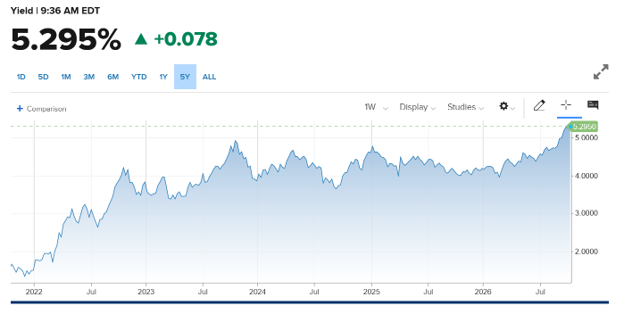
If I make a prediction based on the graph above, we are somewhere near a peak but it will not fall rapidly just as it climbed over a period of two years. This puts inflation not returning to the target for a while. There is one caveat, as inflation stays higher for longer, this will embolden the fed to continue to act aggressively which will likely tip us into a recession (more on this below).
What happens with inflation running hotter for longer?
A recent white paper put out by the federal reserve gives us a hint of what is to come. The white paper highlights that there is a 100% probability of a recession based on past instances of “disinflation”. At the same time, most members of the federal reserve continue to put a soft landing as their baseline case. What do these polar opposite predictions mean for real estate? Which scenario will win in the tug of war? Why will interest rates continue rising?
What was in the Federal reserve whitepaper on inflation?
On the heels of this very hot reading on inflation a white paper was published by the federal reserve bank to determine what happens next..
There were four primary findings:
- It is a bit ironic that the federal reserve released a new research paper on a day when inflation data showed an unexpected spike, the authors found that over 16 episodes of “disinflation” engineered by central banks in the United States, Germany, Canada and the United Kingdom, “we find no instance in which a significant central bank-induced disinflation occurred without a recession.”
- A higher initial inflation rate is associated with a lower sacrifice ratio. Essentially swift and relatively painless disinflations of the past were due to early and sharp policy interest rate increases. In today’s case this would plausibly lead to a mild recession
- Not tightening monetary policy before the disinflation is complete is costly. The central bank must finish what they started to get inflation back to their target. Furthermore, it is a bad idea to change the inflation target.
- Federal funds rates will likely need to go higher
It is also interesting that the paper highlighted that the federal reserve messed up by not raising rates sooner and more aggressively.
The federal open market committee (FOMC) continues saying a soft landing is the baseline
At the same time the paper came out, multiple current members of the federal open market committee put out statements countering the paper and explaining why this time is radically different than any other instance in history.
Currently the markets seem to be accepting this theory as yields are not pricing in a recession and neither is the stock market.
Which scenario will ultimately prevail?
I am going to put my money on the authors of the white paper with a 100% probability of a recession as inflation continues to remain sticky. Although Covid was unique, at the end of the day gravity prevails and we will fall back into old/similar patterns. As the current inflation numbers show, the federal reserve will have to raise rates again and hold for considerably longer.
Remember the federal reserve also stated for years that inflation was transitory and now they are calling for a swift fall inflation. Unfortunately, the numbers do not work. Inflation remains considerably stickier with wages staying high, spending off the charts, and no sign of distress in the economy.
The white paper made another interesting prediction that inflation does not meet the federal reserve target of 2% for a while. This is radically different than the market is pricing in and will ultimately lead to a shock that will cause a recession.
What does this mean for real estate prices and volumes?
- Interest rates will be higher than currently priced in: if it takes until 2025 to get inflation under control this means that interest rates will have to remain higher for longer. This should put mortgage rates close to 6.5 to 7.5% for the next two years unless there is a large market correction.
- Short term volumes will be lower due to golden handcuffs: In the short term as the economy outperforms expectations look for inventory to be held back as people will keep their low rates. This will be a short-term phenomenon as life happens and ultimately inventory will increase
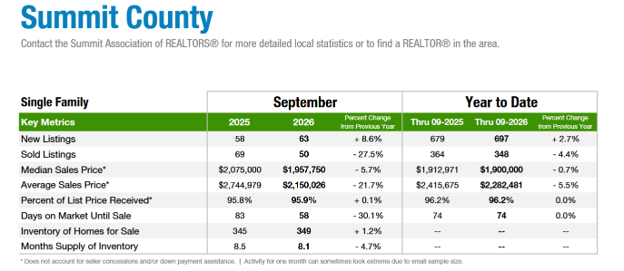
- Market Stuck: The high inflation readings are making the market “stuck” with buyers and sellers at an impasse and volumes plummeting; look at the chart below for Summit County Colorado home to Breckenridge.
- Correction delayed much more than priced in: The correction in the economy will happen, but not happen as quickly as many anticipated. The most likely scenario is mid/late 2027 or even 28.
- Correction could be deeper than anticipated: when a recession happens, the federal reserve will not be able to come to the rescue of the economy with lower rates as inflation would just come back stronger like in the 70s which will lead to much deeper pain than the market thinks.
Summary
Even though the media is pounding on the theme that a soft landing is possible. Do not buy the message that we will be able to achieve a soft landing with no pain for the economy. It is like saying that you can lose weight by eating ice cream and sitting on the sofa. If there is no pain, there is no gain. This theory has held true in every single historical case of disinflation. As the white paper noted, there has always been economic pain to correct the imbalances that led to the high inflation.
The same will hold true in this cycle and will ultimately lead to price corrections in real estate along with a substantial drop in volumes. Prices are not sustainable with the current rates. Furthermore, higher rates will ultimately slow the economy leading to higher unemployment that will reduce demand.
Although the impending economic storm is at least 6 months or more out, history has shown with 100% certainty that it will happen and there will be pain for the economy and a correction in pricing of assets from Real estate, stocks, bonds, and everything in between. Don’t forget the reminder from Mark Twain, “history doesn’t repeat, but rhymes”.
Additional reading/resources
- https://www.fairviewlending.com/will-house-prices-rise-and-defy-all-odds/
- https://www.fairviewlending.com/7-percent-mortgage-rate-impact-on-real-estate/
- https://www.cnbc.com/2023/06/13/cpi-inflation-report-may-2023-.html
- https://www.wsj.com/articles/why-inflation-around-the-world-just-wont-go-away-94552e39?mod=hp_lead_pos3
- https://www.bloomberg.com/news/articles/2023-05-26/hot-inflation-puts-another-fed-hike-in-play-for-june-or-july?srnd=premium
- https://www.cnbc.com/2023/05/26/inflation-rose-0point4percent-in-april-and-4point7percent-from-a-year-ago-according-to-key-gauge-for-the-fed.html
- https://www.reuters.com/business/retail-consumer/fed-needs-recession-win-inflation-fight-study-shows-2023-02-24/
- https://www.bloomberg.com/news/articles/2023-04-12/us-core-cpi-rises-firmly-keeping-may-fed-rate-hike-in-play?srnd=premium
- https://www.cnbc.com/2023/02/24/the-fed-cant-tame-inflation-without-more-hikes-paper-says.html
- https://www.clevelandfed.org/collections/speeches/2023/sp-20230224-comments-on-managing-disinflations
- https://www.bloomberg.com/news/articles/2023-02-24/fed-may-need-to-hike-to-6-5-to-cool-prices-new-study-says
- https://car-co.stats.showingtime.com/docs/lmu/x/SummitCounty?src=page