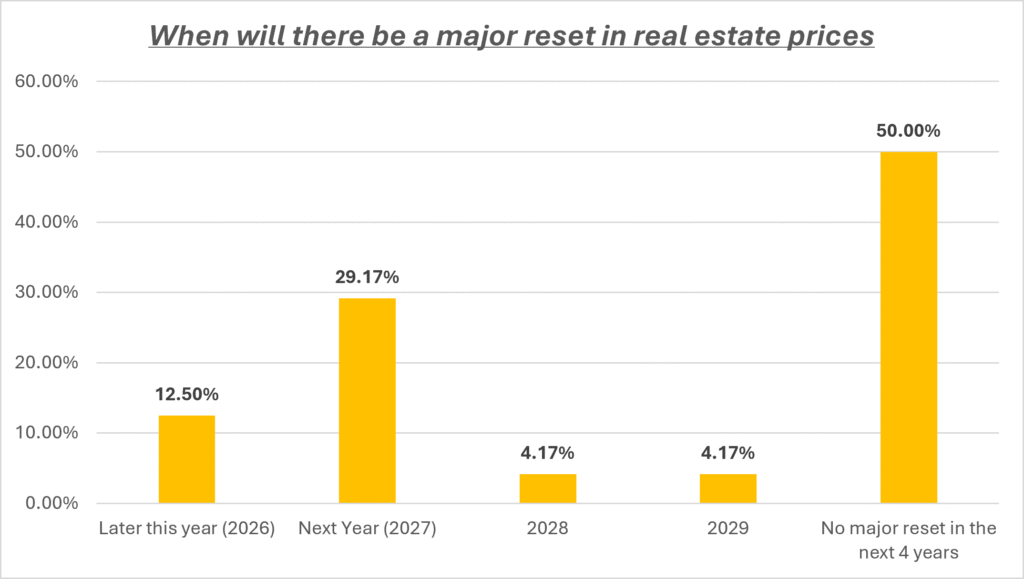
For years, myself, and many others have thought that interest rates were the predictor of housing prices. Fast forward to post covid where interest rates have doubled and yet housing prices remain high and are still trending higher in many markets. What other metric should watch to see where housing prices are heading? What does a drop in stocks mean for the housing market? Above is a chart of responses from a few months ago of my readers on when we will see a reset.
Is there a correlation between stock market and real estate prices?
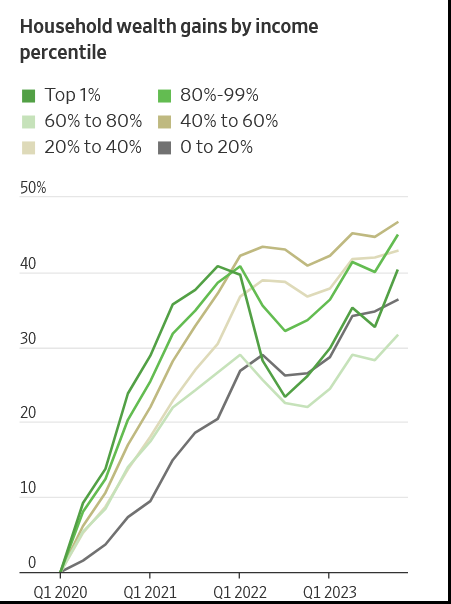
Yes, there is an increasingly high correlation between stock market performance and real estate prices. The stock market has been on a tear until recently. In the past, interest rates were the primary driver of real estate prices, as rates moved substantially higher, property values dropped. This has not occurred in this cycle because as rates moved substantially higher so did almost every other asset from stocks to bitcoin to many commodities. This has created a substantial wealth effect for most Americans as shown in the chart below. The amount of wealth created in this cycle is astounding.
This wealth has allowed more people to buy properties all cash and/or absorb higher prices. As the stock market remains high so have housing prices and the correlation between the two has only increased during the post pandemic cycle.
Are high real estate prices causing prices to go higher?
Yes, it sounds counterintuitive, but high prices are creating “higher prices” when properties are sold. Along with the stock market, the high value of houses themselves is now keeping prices high creating a loop effect. If you are going to sell your house, you can get substantially more than five years ago, this will enable many buyers to buy their next house in cash especially if they move to a lower cost area. This in turn is driving up prices in less expensive markets as there is more demand from other areas.
Will interest rates stay higher for longer?
Housing is the number one driver of inflation comprising over a third of the consumer price index. As housing prices stay higher along with rents, it will be difficult to see a major reset in inflation. Couple this with high gas prices, labor rates, etc… inflation is going to be challenging to tame for a while. The market is currently pricing in at least one more increase this year. I don’t foresee a big change in our current rates for a long time and there is a tilt higher which very low probability of substantially lower rates for a long time.
When will there be a reset in real estate prices?
Prices of houses will continue near their peak until there is a stock market reset and people “feel” less wealthy. Currently interest rates today are likely not high enough for this to occur which will keep the federal reserve on a path for higher for longer until there is a reset in asset prices. Without a reset in the stock market and in turn housing the economy will be stuck where it is today for a bit longer.
Will there be a stock market reset and how does this impact real estate?
Regardless of your optimism of the economy and AI eventually there will be a resent in the next 2 years or so as interest rates stay high and the market digests a new normal in the economy.
The head of market strategy at a London investment bank has a stark warning for investors: the artificial-intelligence trade may soon be over in what could trigger the most severe market crash since the global financial crisis.
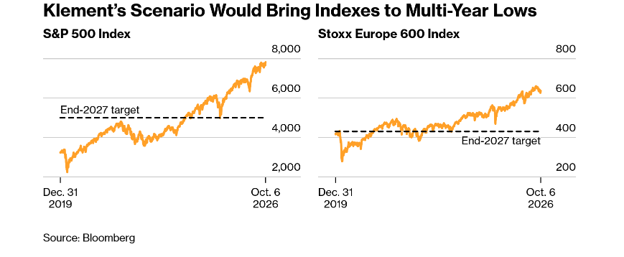
“My core conviction is that the AI bubble will either burst in 2027 or in 2028, so sometime in the next two years,” Klement said in an interview. Hyperscalers’ free cash flows are largely depleted, while the cost of debt is rising quickly and becoming prohibitive for these firms, he said.
Klement’s 2027 year-end target of 5,000 points for the S&P 500 implies 36% downside from current levels. That’s by far the most bearish of seven other strategists tracked by Bloomberg, who on average look for potential upside of 14%. Klement sees Europe’s Stoxx 600 falling to 430 points, more than 30% below current levels.
What do long-term forecasts for the stock market mean for real estate prices?
The headline says it all “ Decade of big S&P 500 gains is over”. The predictions for the stock market are pretty grim:
” US stocks are unlikely to sustain their above-average performance of the past decade as investors turn to other assets including bonds for better returns, Goldman Sachs Group Inc. strategists said.
The S&P 500 Index is expected to post an annualized nominal total return of just 3% over the next 10 years, according to an analysis by strategists including David Kostin. That compares with 13% in the last decade, and a long-term average of 11%.
They also see a roughly 72% chance that the benchmark index will trail Treasury bonds, and a 33% likelihood they’ll lag inflation through 2034.”
Essentially real estate rode the asset appreciation wave of the stock market up and is now married to the new reality of substantially lower returns. Based on the predictions of Goldman Sachs this would correlate to a similar scenario for real estate with returns averaging around 3% over the next 10 years, this is a huge drop from the 20%+ we saw some years during the Covid boom.
Will there be more risk this cycle due to stock market and real estate correlation?
Although the wealth effect has created huge positives for the housing market with stable to rising prices in face of higher interest rates, the party cannot last forever. Unfortunately we have already seen the upside over the last 10 years or so.
The downside risk is much more likely. With the huge run ups in wealth and the strong stock market there is a much higher correlation between housing and the stock market. As one goes down so will the other. As we have seen throughout the years in economics, high correlations are great when markets are increasing but when the winds change and there is a reset, the downside risk is amplified.
Currently with assets continuing to power forward real estate values will continue at records until there is a big reset in the stock market. The increased volatility in the stock market should be a wakeup call as the stock market does not go up into perpetuity. Furthermore, values are extremely lofty based on any historical metric which further enhance the risk.
A reset in the stock market will ultimately lead to a much greater reset in real estate values than in the past due to the higher correlation. The million dollar question is when will this occur and how much will housing prices drop. My gut says sometime next year, the reset will occur as the everything rally in stocks and other assets peters out, but the real story is that the decade of huge real estate gains is likely over just like we will see in the stock market which means housing prices are basically going to stay at best case even with inflation (basically 2-3% a year for the next 10 years) for the next decade or worst case have a reset and underperform inflation.
On a side note, remember that real estate is market specific so certain cities will perform better than others due to demographic shifts that will alter individual real estate markets. Furthermore in every single cycle there are opportunities for buyers that are liquid so when there is a reset there will also be opportunities to pick up properties (especially commercial real estate) at very attractive values.
Where can I learn more about the stock market and impact on real estate prices?
- https://www.nar.realtor/blogs/economists-outlook/the-share-of-all-cash-buyers-highest-since-2014-at-32-of-all-buyers
- https://www.bloomberg.com/news/articles/2024-10-21/s-p-500-s-decade-of-big-gains-is-over-goldman-strategists-say?srnd=homepage-americas
- https://www.fairviewlending.com/stock-market-reset-impact-on-real-estate/
- https://www.bloomberg.com/news/articles/2026-10-08/ai-bubble-risks-worst-s-p-500-crash-since-2008-strategist-says?srnd=homepage-americas
- https://www.fairviewlending.com/will-there-be-a-major-stock-market-correction-what-is-the-impact-on-real-estate/