From NY to LA cities have been clamoring as expenditures have continued to outpace revenue. The easy fix is now the “mansion tax” to force the wealthy to pay more without impacting “ordinary” taxpayers. Sounds like a great solution until the real data comes in. What has happened because of the “mansion” tax? Is it really a “risk free” tax to plug budget shortfalls?
The Mansion tax in Los Angeles
The law in Los Angeles claims 4% of the gross value of most property sales starting at $5.3 million and then jumps to 5.5% for sales at or above $10.6 million. The money is set aside for nonprofit affordable housing built by a local union that campaigned for the ballot initiative, as well as for rental assistance and eviction defense.
On the surface it sounds innocuous, but the 4% applies to all properties from an apartment building to a mansion, each is required to pay 5.3% of the gross sales price to the government.
How much did the LA mansion tax raise?
City officials initially projected the transfer tax would bring in $600 million to $1.1 billion in annual revenue. Over three years, city figures show total collections of $1.19 billion. This is roughly 400 million a year, roughly 35% of the predicted revenue
How many new housing units were constructed from the increased tax revenue?
Only $119.4 million of those funds had been paid out as of April 30, according to city figures. Most of the spent money has gone through a pair of nonprofits, the Legal Aid Foundation of Los Angeles and the Southern California Housing Rights Center, for eviction-defense cases and emergency rental assistance for thousands of households.
Hundreds of millions of dollars more has been committed to building or rehabilitating several thousand affordable-housing units that supporters say might not otherwise go forward.
The 1,790 new apartments currently slated to receive funding from the tax are expected to cost an average of $779,955 each, according to city documents. Current and former city officials said tight restrictions on how the money is used have slowed the process and driven up costs.
Even in LA, a unit cost of almost $800k is not considered affordable for service workers, teachers, firefighters, etc…
Real numbers show a net loss of 9k units/year
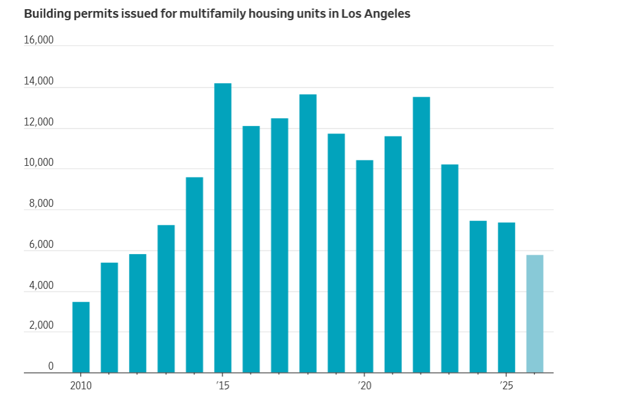
Although 1800 units are supposedly being constructed, due to the new law multifamily construction has come to a halt dropping from a high of almost 14k/units per year to roughly 5k units per year leading to a net loss of almost 9k units/year.
Because the property-sales tax applies whether or not a project is profitable, developers said it has led their investors and lenders to bypass Los Angeles projects.
“We have not started any multifamily housing in the city of L.A. since the passage” of the tax, said Chris Tourtellotte, managing director at LaTerra Development. The firm, which Tourtellotte said in the past built 500 to 1,000 units a year in the city, is now working on projects in Burbank and Sacramento in California as well as Texas and New Mexico.
Mansion taxes leads to less affordable units and less revenue
Along with less units being built, the transaction volume of properties above 5.3 million has also come to a screeching halt. Assuming a 5% transaction fee this means billions of lost revenue for realtors, title companies, mortgage companies, etc… Essentially the mansion tax has led to considerably less tax revenue and turned into a giant transfer from private to public coffers leading to huge losses in constructed units and less money in constituents pockets.
Unintended consequences of Mansion taxes are huge and yet cities/states ignore
Thousands of units have not been constructed, which ironically is the opposite of the intended law when it was sold. Furthermore, hundreds of millions of transactions have been lost as people refuse to buy and/or refuse to sell due to the 5% fee. “It’s a classic cautionary tale about this sort of ballot-box legislation,” said Michael Manville, a professor of urban planning at the University of California, Los Angeles.
The numbers do not lie, but politicians and voters in many areas can’t seem to head the reality that the tax the rich scheme does not solve the fiscal issues facing many cities it actually makes it worse. It is a bit ironic that cities and states throughout the country are still jumping on the “tax the rich” bandwagon even though the numbers clearly show in LA that this is a terrible idea that has far reaching implications including lost revenue and people making investments elsewhere without the ludicrous tax structure.
Additional Reading/Resources:
- https://www.wsj.com/economy/housing/los-angeles-tried-to-tax-mansions-apartment-construction-tanked-1b908564?
- https://www.fairviewlending.com/what-is-hiding-in-the-real-estate-market/
- https://coloradohardmoney.com/lakewood-defeats-upzoning/
- https://coloradohardmoney.com/why-are-colorado-property-taxes-rising/
- https://lewis.ucla.edu/2025/05/14/los-angeless-mansion-tax-has-raised-less-money-for-affordable-housing-than-expected-lewis-center-researchers-explain-why/