It is astonishing that house prices continue higher in the face of high interest rates and a slowing economy. The media keeps pinning the continued appreciation on lack of supply even while listings in places like Denver have jumped 33% year over year. What is really driving the increase in house prices and will it last?
Supply not the reason for increases in house prices: Look at Denver, CO
I’ve read in hundreds of articles that the reason for the increase in house prices is the huge shortage of houses available for sale. Using that assumption I looked at Denver, CO, where there has been a 33% increase in listings. With this huge jump in listings, I would suspect that we would start to see price declines, but the opposite is now occurring. Houses in Denver are increasing in price in light of the increase in supply.
At the same time migration to Denver has come to a screeching halt due in part to the very high real estate prices. So what is really driving real estate higher.

The wealth effect is increasing real estate prices.
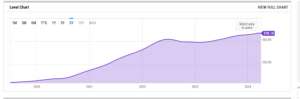
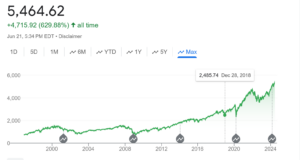
I do not think that the market, including myself, have adequately priced in the huge impacts of the wealth effect. Look at these two charts for the last 5 years of appreciation in the S&P 500 and the Case Schiller index. Notice how closely related they are. There is obviously more noise in the S&P 500 as there is daily volatility, but the trend is strikingly similar. As the stock market has trended so has real estate.
Does the wealth effect hold over a longer period of time
After looking at the charts above, I was curious to see how this theory has panned out over a longer period of time. Look at the two charts below, once again they are strikingly similar with stocks and house prices going up almost identically.
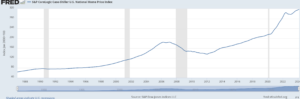
Stock market driving real estate appreciation not interest rates
Although historically the real estate market was driven by mortgage rates, we are seeing something radically different play out in today’s economy. The wealth affect from stocks/other assets continues to drive the real estate market higher. This explains why even with mortgage rates triple what they were a few years ago and supply substantially increasing, house prices can still increase.
The wealth effect can work the inverse
It is important to note, having a high correlation between assets is great when everything is increasing, but when the market declines, we can have much more severe swings. We saw that in 2008 when there was a sharp correction in the stock market and real estate. The higher highs mean that there will be lower lows so the risk of huge swings is amplified. We saw this in the data in 2008 and could see the same thing occur when the stock market hits a reset.
Summary
Do not buy the media hype that historic housing shortages are the driver of our recent home appreciation. Historically, higher rates would lead to a softening of asset prices from real estate to stocks. We can clearly see this theory does not work with the recent data in Denver, CO The crazy part is in this cycle the opposite is occurring with basically all asset prices from houses to stocks rising in tandem. This has worked great over the last five years as both real estate and stock values have soared. This trend is continuing in the recent data with house prices hitting records in light of increasing supply and high rates.
The economy will eventually hit another cycle like it always does. Regardless of the soft or hard landing narrative, eventually there is an unforeseen event that changes the game in the economy which leads to a reset. Unfortunately real estate, like other assets, will be impacted. The downside is that when there is a reset in asset prices, the downside risks are amplified due to the high correlation with other assets like stocks which could create a wild ride in the real estate market. Stay tuned to see how this shakes out, but rest assured that eventually prices will go down on stocks and in turn real estate due to their high correlations.
Additional Reading/Resources