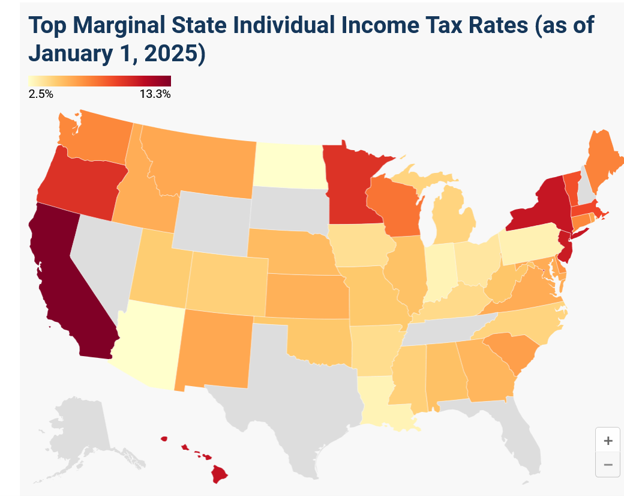
IRS data show that taxpayers keep fleeing high tax states; should you follow the wealthy residents with your real estate investing? Is the sudden shift in residents to lower cost states a blip or a new trend? Take a look at the two charts below, what is the correlation between high tax states and residents leaving these same states? What is the importance of the two charts below and how should it influence your real estate decisions?
The wealthy are voting with their feet
As the differential in tax rates increase amongst states, residents are voting with their feet. The latest IRS data includes the adjusted gross income (AGI) of tax filers who moved between and within states between 2022 and 2023. Not surprisingly, overall migration ebbed from record highs in 2020 and 2021 during the Covid lockdowns. A mortgage lock-in effect and rising interest rates also resulted in fewer people moving.
Yet states with the highest taxes continue to lose the most income to other states. California lost on net $11.9 billion, mostly to Texas, Nevada and Arizona. Other big losers include New York ($9.9 billion), Illinois ($6 billion), Massachusetts ($4 billion), New Jersey ($2.6 billion), Maryland ($1.8 billion) and Minnesota ($1.5 billion).
What are the top high tax states losing residents?
- California: Experiences the largest net population and taxpayer outflow in the country, losing billions in adjusted gross income primarily to states like Texas and Arizona.
- New York: Ranks near the top for heavy tax burdens and sees a steady domestic exodus of residents and high earners heading down South.
- Illinois: Suffers continuous population decline driven by high property and overall tax rates.
- New Jersey: Combines some of the nation’s highest property taxes with steep income brackets, prompting net out-migration.
- Massachusetts: Shows significant domestic out-migration and multi-billion dollar taxpayer income losses due to a high cost of living.
- Connecticut: Continues a multi-year trend of residents leaving for more tax-friendly states like Florida and Texas.
Top Low-Tax States Gaining Residents
- Florida: Leads the nation in net domestic migration, fueled by no state income tax and an overall low tax burden.
- Texas: Continues to draw hundreds of thousands of new residents annually with zero personal income tax and a pro-business environment.
- Tennessee: Boasts rapid population growth backed by no tax on wage income and low overall individual tax obligations.
- North Carolina & South Carolina: Feature moderate-to-low income tax rates that are aggressively dropping alongside steady, high-volume inbound migration.
- Nevada & South Dakota: Both maintain no state income tax and rank favorably for low individual tax structures, drawing steady streams of new homesteaders.

High tax states getting worse, not better
Take California, there is a new ballot initiative for a wealth tax. California’s proposed wealth tax is a voter initiative on the November 3, 2026 ballot as Proposition 40 (the “2026 Billionaire Tax Act”). It seeks to levy a one-time 5% tax on the worldwide net worth of California residents and trusts valued over $1 billion. This will further the tax burden on wealthy taxpayers and accelerate the move. For example why would someone stay in California to pay a one time tax of 50 million dollars to the state of California when they can move just about anywhere else to avoid the fee?
List of high tax states is fluid
It is also important to note that the list of high tax states is Fluid. For example:
- Colorado has a ballot initiative to increase the top tax rate to around 10% putting it in line with Oregon, California, and other states.
- Georgia has passed legislation whereas the income tax rate will drop to 3.99% which would put it in the lower tier of income taxes in the country.

Flight to lower tax states will not only continue but accelerate
Unfortunately, capital is fluid within the US and to some extent worldwide. High net worth individuals will move to lower tax rates when they get out of line. For example, Colorado is proposing a 10% top tax rate, why would someone subject to the tax not move next door to Utah at 4.5% or Wyoming which has a zero percent tax rate. For someone making a million dollars a year they savings could be 100k in taxes
High net worth not only moving themselves but their companies
Many high-net-worth individuals are also prominent in the business community. For example, if someone is making a million dollars a year they are either high up in the company, run the company, or run their own business. Not only are the high net worth fleeing, but they are moving their companies as well. A good example is Elon Musk who not only moved to Texas but also moved Spacex and thousands of employees.
Huge problem for high tax states when there is a recession
Many high tax states have not figured out that income tax is only one piece of the equation. These same high net worth residents also pay substantial sales tax. For example someone like Elon Musk has airplanes, cars, artwork, etc.. all that he pays sales tax on. This sales tax revenue is also substantially reduced when residents leave and will be a double hit when there is a recession.
Even in the last recession high net worth still spent more money than others which means that the same high tax states will have less income tax from residents and also substantially less sales tax revenue. When you couple the loss in revenue with out of control spending you set up a disaster situation for many state budgets.
Even without a recession we are already seeing this in many states. For example, Colorado faced a budget deficit of roughly $1.2 billion to $1.5 billion for the 2026–27 fiscal year. What happens when there is a recession?
Your investing should follow the wealthy to lower tax states
The idea of higher taxes driving location decisions is not theoretical anymore. We can clearly see through IRS data and state budget collections that higher tax states are not only losing residents, but also losing tax revenue from income taxes and sales taxes. This is creating a negative cycle of states needing even increased taxes as their spending continues to outpace any possible revenue. For example, the wealth tax in California or Colorado’s initiative to increase income taxes to 10% are actually leading to declining tax collections. Unfortunately, the pattern of unlimited spending while trying to “soak the rich” does not work in the real world.
When you are investing you need to look at a horizon of 5-15 years minimum depending on the property. Your investing decisions should be driven by what the wealthy are doing as those states they are moving to will have much healthier tax collections than others. This will allow lower taxes and also an increase in residents which will lead to faster growth than high tax states. In summary, let the charts above guide you where to invest for the next 10-20 years as the saying goes… numbers do not lie!
Additional Reading/Resources
- https://www.wsj.com/opinion/states-taxes-migration-democrats-irs-f13d9d04?mod=mhp
- https://coloradohardmoney.com/is-affordable-housing-worth-2-million-a-unit/
- https://coloradohardmoney.com/colorado-joins-tax-increase-line/
We are a Private/ Hard Money Lender funding in cash!
If you were forwarded this message, please subscribe to our newsletter
Glen Weinberg personally writes these weekly real estate blogs based on his real estate experience as a lender and property owner. I’m not an armchair reporter/writer. We are an actual private lender, lending our own money. We service our own loans and own commercial and residential real estate throughout the country.
My day job is and continues to be private real estate lending/ hard money lending which enables me to have a unique perspective on the market. I don’t accept any paid sponsorships or ads on my blog to ensure accurate information. I’ve been writing this for almost 20 years and have over 30k subscribers. Please like and share my blogs on linkedin, twitter, facebook, and other social media and forward to your friends 😊. I would greatly appreciate it.
Fairview is a hard money lender specializing in private money loans / non-bank real estate loans in Georgia, Colorado, and Florida. We are recognized in the industry as the leader in hard money lending/ Private Lending with no upfront fees or any other games. We fund our own loans and provide honest answers quickly. Learn more about Hard Money Lending through our free Hard Money Guide. To get started on a loan all we need is our simple one page application (no upfront fees or other games). Learn how to find a reputable hard money lender and why Fairview is the best hard money lender for investors.
Written by Glen Weinberg, COO/ VP Fairview Commercial Lending. Glen has been published as an expert in hard money lending, real estate valuation, financing, and various other real estate topics in Bloomberg, Businessweek ,the Colorado Real Estate Journal, National Association of Realtors Magazine, The Real Deal real estate news, the CO Biz Magazine, The Denver Post, The Scotsman mortgage broker guide, Mortgage Professional America and various other national publications.
Tags: Hard Money Lender, Private lender, Denver hard money, Georgia hard money, Colorado hard money, Atlanta hard money, Florida hard money, Colorado private lender, Georgia private lender, Private real estate loans, Hard money loans, Private real estate mortgage, Hard money mortgage lender, residential hard money loans, commercial hard money loans, private mortgage lender, private real estate lender, residential hard money lender, commercial hard money lender, No doc real estate lender