President Trump recently announced a new ban on large investors buying single family homes. Ironically this bill is almost identical to what Biden/Harris had proposed a few years ago. Why the interest in banning investors from purchasing single family homes? Will this help or hurt home prices? Does this new proposal remove the “floor” under house prices?
What is in the proposal to ban institutional home buyers?
Currently the details are slim, but the proposal to ban institutional investors likely will use the template created by Biden/Harris that was blocked in congress years back. Here is what the last proposal was, which is likely a good starting point of how this new ban on large investors will play out. There is a question in my mind if you can outright ban a company from owning more than x units, but the bill can make it unprofitable for most to own large quantities of single-family rental homes
Here are the key highlights of the prior Bill:
- Investors who purchase more than 50 houses would be restricted from deducting interest and depreciation.
- If a property is sold to a qualified owner occupant or non profit then interest and depreciation can be taken in the year of the sale.
- Bill applies to any property less than 4 units. Townhomes/condos are considered individual units and subject to the bill.
- The new regulations will apply to any properties “placed into service” after the effective date of the signing into law.
Is a proposal to ban large investors even needed?
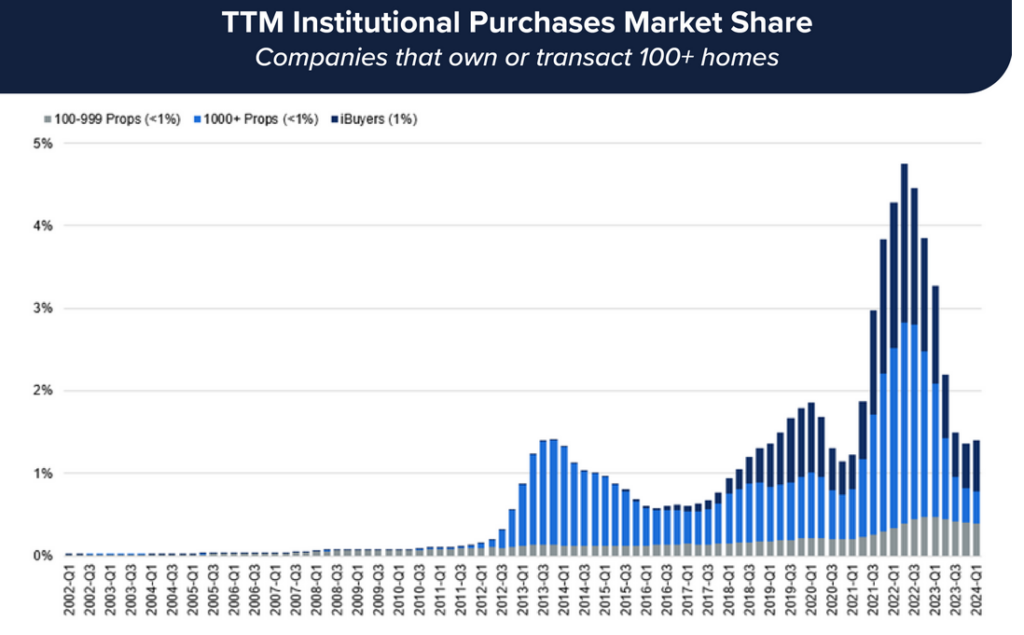
I think it is ironic that this bill is now being introduced. Homes purchased by real estate investors saw their largest annual decline on record in the first quarter of the year amid falling home values and high mortgage rates, according to a report released on Wednesday.
Real estate investors purchased 48.6% fewer homes in the first quarter of 2023 than they did a year earlier as elevated interest rates along with declining rents and housing values ate into potential profits. That’s the largest annual decline on record, and outpaced the 40.7% drop in overall home purchases in the major metros tracked by Redfin.
There likely will be huge loopholes when banning large investors
The way the prior bill is written there are some glaring loopholes. Someone could set up separate entities that max out at 50 investment single family homes. For example, an entity could be created for Denver that holds 49 homes to get around the new law. It would be a pain, but companies would do this order to save substantial dollars on interest and depreciation.
Are large investors really driving up home prices?
I don’t see the merits of how banning large investors will reduce home prices. Many institutional investors now are focused on build to rent subdivisions. This means that a large wall street firm would contract with a builder to construct ground up a for rent subdivision. This essentially increases the supply of homes in the area.
A builder is unlikely to build a large spec subdivision without demand. If institutional investors are banned, builders will merely stop building the increase in houses for the wall street firms. This will substantially decrease the amount of homes built which will ultimately keep prices higher or at the least about the same.
How will this new ban on investors impact what occurred in the last recession
In the last recession house prices plummeted. Investors came in and bought in bulk large pools of houses. For example if a builder went bust, a bank would end up with an entire subdivision and would sell this off to investors. Ironically many of these sales were made by the FDIC when banks failed. It was most efficient to get rid of these loans in bulk as opposed to individually due to carrying costs, etc… When there is another economic downturn, there will not be buyers that are willing to take the houses in bulk from the FDIC which will create further problems when house prices reset. Taxpayers will then in turn absorb these losses.
Will this new ban on investors have the intended result of lower house prices?
Absolutely not. There is this theory that institutional investors are somehow distorting the single family home market. Currently, institutional investors only own about 0.2 percent of all single-family homes, and just one-percent of rental homes, according to recent data presented to the U.S. Senate by The Heritage Foundation. The Heritage Foundation also pointed out that in no state, do institutional investors own more than 1 in 100 of all available housing.
“‘Institutional owners’ of rental properties are being scapegoated for the rise in home prices and rental costs,” Joel Griffith, a research fellow explained. “…The bottom line is that institutional SFR ownership is not measurably impacting local home price dynamics to the upside.”
Huge unintended consequences of banning large investors
Although the intention of the bill is to lower prices for other homeowners to buy properties, the unintended consequences of this legislation will have the opposite effect.
- Less supply: Many large institutional investors are now building “for rent” subdivisions which is drastically increasing the supply of rentals in many markets. With the new legislation, these projects will not be economically feasible leading to a large drop in supply. As supply drops, prices will rise for both rentals and homes for sale.
- Allow prices to fall further in downturn: We have seen in prior downturns that institutional investors put a “floor” on how much prices could fall. Institutional investors were the largest purchasers of defaulted notes and properties. When there is a repeat of 2008, the market will fall considerably more if there are not deep pocketed buyers willing to step in. Imagine if every property held by the FDIC or the Fannie Mae, etc… could only be sold to an individual owner or a very small investor. It would take 3-5 years to get rid of all the properties leading to a much worse outcome and slower recovery.
- Slippery slope on business investment: The whole premise of targeting one specific type of buyer in a specific industry is very concerning. What happens if next they say that you can’t depreciate apartments or industrial properties or any myriad of other business assets. This proposal is going down a very slippery slope that will have far-reaching ramifications for future business investment.
- Move investments to apartments: The proposal to ban large investors will shift demand to the apartment market and eliminate many single family corporate rentals. For example, instead of building a detached single-family community, they will build attached homes that are “apartments” and not covered under the law. This will eliminate the ability for many lower income households to live in a single-family home.
What has caused the huge rise in prices?
It is interesting that investors are being scapegoated for the huge rise in prices as the real culprit is interest rates & build costs. As interest rates were pushed to historic lows during the pandemic it created ripe conditions to use ultra cheap leverage to make hefty returns on real estate. It wasn’t just institutional investors that benefited as individuals and smaller investors also took advantage of the ultra-low rates to buy a second home, or upgrade to a larger home, etc… The huge demand for real estate was driven by the once in a lifetime low rates. This in turn pushed up real estate prices and in turn rents.
Build costs have also skyrocketed throughout the country due to government regulation, labor costs, land costs, material costs, etc… which makes it unprofitable to build many homes at lower price points where there is the most demand as it is not profitable. The increase in build costs will not go away especially in many high cost areas like Denver that just increased the minimum wage to almost $20/hour and continue to add “green building” requirements that substantially increase the costs from an all-electric home to energy efficiency standards. Each item costs money and when you couple this with increased material and labor costs, the numbers cannot work for building cost effective homes.
Banning institutional investors hurts the market long term
This new proposal to target large investors will not have the intended effect of lower prices. The ban on large investors will do the opposite and raise prices over the long term due to a reduction in inventory/investment in single family rentals. Furthermore, this proposal creates a slippery slope and opens up pandora’s box on who could be the next target. This will ultimately lead to less investment and even lower inventory, furthering price increases and rent increases.
The real solution is to let the markets work as intended with increasing supply and less government subsidization of ultra-low rates. The ban on large investors is the wrong solution as the market is already resolving itself without this bill. We are already seeing this happen in real time with investors cutting their purchases as rates have risen. Even with the reduction in investor purchases prices are not falling in most markets as the real culprit continues to be the lock in effect of ultra-low interest rates and extremely high costs to build new houses due to government regulations.
Additional Reading/Resources
- Trump says U.S. to ban large investors from buying homes
- Trump Proposal on Housing Would Not Make It More Affordable – Bloomberg
- https://www.banking.senate.gov/imo/media/doc/stop_predatory_investing_act_one_pager.pdf
- https://www.banking.senate.gov/imo/media/doc/stop_predatory_investing_act1.pdf
- https://thehill.com/business/4091602-senate-democrats-take-aim-at-investor-home-purchases/
- https://news.theregistryps.com/as-institutional-investors-buy-up-single-family-homes-everyday-americans-must-sprint-to-catch-the-american-dream%EF%BF%BC/
- https://www.fairviewlending.com/new-senate-bill-predatory-investing-to-curb-corporate-investors-from-buying-up-single-family-homes/
- https://coloradohardmoney.com/blog/
We are a Private/ Hard Money Lender funding in cash!
If you were forwarded this message, please subscribe to our weekly newsletter to stay on top of news that moves real estate markets
I need your help! Don’t worry, I’m not asking you to wire money to your long-lost cousin that is going to give you a million dollars if you just send them your bank account! I do need your help though, please like and share our articles on linkedin, twitter, facebook, and other social media and forward to your friends 😊. I would greatly appreciate it.
Written by Glen Weinberg, COO/ VP Fairview Commercial Lending. Glen has been published as an expert in hard money lending, real estate valuation, financing, and various other real estate topics in Bloomberg, Businessweek ,the Colorado Real Estate Journal, National Association of Realtors Magazine, The Real Deal real estate news, the CO Biz Magazine, The Denver Post, The Scotsman mortgage broker guide, Mortgage Professional America and various other national publications.
Fairview is a hard money lender specializing in private money loans / non-bank real estate loans in Georgia, Colorado, and Florida. We are recognized in the industry as the leader in hard money lending/ Private Lending with no upfront fees or any other games. We fund our own loans and provide honest answers quickly. Learn more about Hard Money Lending through our free Hard Money Guide. To get started on a loan all we need is our simple one page application (no upfront fees or other games).
Tags: Hard Money Lender, Private lender, Denver hard money, Georgia hard money, Colorado hard money, Atlanta hard money, Florida hard money, Colorado private lender, Georgia private lender, Private real estate loans, Hard money loans, Private real estate mortgage, Hard money mortgage lender