
As I was hiking with my family almost at treeline in Colorado, one of my dogs suddenly went on point. To our surprise there was a brown bear sauntering through the field (sorry looks like a brown sheep as we are a good distance away on a ridge). In 30 years we have never seen or heard of a brown bear at this elevation as there is no food for them this high up. Why is seeing a brown bear at treeline so profound? What is the new risk that the bear highlights for today’s economy?
A brown bear at treeline highlights risk
In 30 years we have never encountered a brown bear (for clarification it is actually a black bear that is brown) at this elevation nor see any sign of them like footprints, scat, etc… It is very rare to see a brown bear at this elevation as they typically are much lower eating berries. At treeline there is not much up there other than grass and rocks so food is very limited. So when we crested over the ridge and saw the bear we were a bit surprised. Fortunately we were a good distance away (hence the picture zoomed in above that looks like a sheep) so not in any direct danger, but it did get us thinking about the risk of bears when we were camping.
After we were well past the bear, it got me thinking about risk in general. What risks are out there that I am not anticipating. Is there a brown bear in the economy that we have no idea about?
The Brown bear is indicative of new risk in the economy.
The brown bear is a wake-up call that we can encounter unanticipated risks at any time anywhere. Why is this so important now? With everything going on in the economy now, there are a million different risks from interest rates to wars to stock market froth to ????? From history we theoretically should know how to price in the risks. For example, we can look at 2008 and clearly see what happens with looser underwriting and how it ultimately washed through the economy. On the surface it all sounds pretty straightforward of how we are pricing in risk in the economy, but the brown bear at treeline upsets our common theories.
What if we as an economy are not accurately pricing in risk as the risk has changed and we don’t actually know what the risk is now?
Changing metrics are increasing risks that we don’t know about
For example, we can look historically and know that someone with a 750 score and 80% loan to value loan will perform a certain way when the economy resets. We have tons of data and can pretty accurately predict what happens and take the appropriate loss reserves. But what if today this entire theory no longer works because the metrics have changed.
To highlight what I am talking about above, there is a flight from Steamboat Springs (a ski town) to Denver, CO, the flight time is 30 minutes wheels up to wheels down. There was recently a scathing report that showed Steamboat was one of the worst on time airports in the entire country. The airlines and the airport were not having any of that negative publicity so they knew they had to resolve the on time issues quickly.
Through a miracle, Steamboat is now one of the best on time airports in the entire country and the fix was easy and cost nothing. All the airlines just increased the “flight time” on their schedule. So instead of saying the flight to Denver is 45 minutes, they publish that the flight time is 90 minutes; problem solved, all the flight are on time now without doing anything to fundamentally alter the issues leading to delayed flights (de icing, baggage loading, not having jet bridges, pilots who don’t know how to fly into the mountains, etc…).
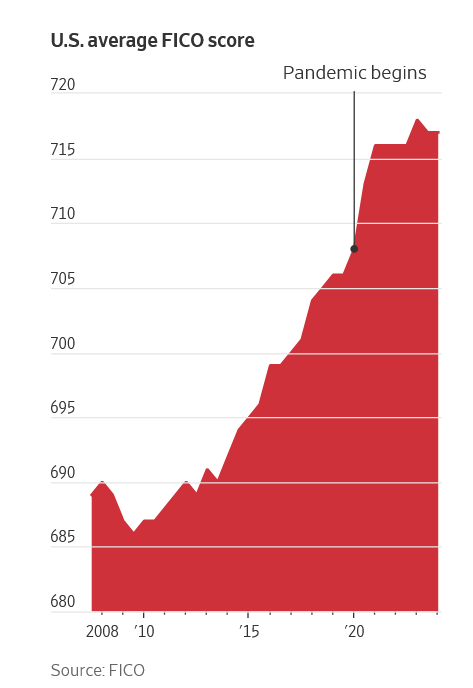
The new changing metrics in the economy are drastically altering risk
Look at the graph above of credit scores. Suddenly everyone in the US is now considerably more credit worthy with scores surging over 30 points taking many subprime borrowers to prime borrowers overnight. Unfortunately I am going to call Bullshit that everyone is suddenly much more credit worthy. The real answer is that the metric changed to ensure on paper everyone looked more credit worthy. The games the government played to increase credit scores is the same game the airlines did in Steamboat to change the metric so it looks better without fundamentally changing anything!
The changing metric of credit scores
The government knows how important a credit score is so over the last 10 years they have worked diligently to artificially increase scores. Sorry to burst the bubble, credit scores have not increased due to any fundamental changes by Americans. Here are four drivers:
- Pandemic stimulus: The government printed money and handed it out like candy to American’s that could use these funds to pay down credit card debt, car debt, etc…
- Less items on credit report: here are just a few items that no longer show on your credit reports:
- Judgements: for example someone didn’t pay their rent and the property owner got a judgement, this does not show on the credit report
- Tax Liens
- Medical Debt
- Student Debt for the last 5 years
- Student loan payments: very few have paid student loans over the last 5 years, this has given a huge boost in cash flow to millions of borrowers, even today almost 7 years after the pandemic many student loans are still in forgiveness.
- Credit Score Shopping: The government is now allowing borrowers to choose either Fico or Vantage score which will drive a race between the two bureaus to produce even higher credit scores furthering the grade inflation
- Buy now pay later: these loans are not on credit reports so someone could use a BNPL loan with no impact on their credit as opposed to a credit card
Why is important to look at grade inflation on credit scores
The government is super happy that everyone has higher credit scores as mortgage rates for borrowers are lower, car payments lower, they have more credit available, etc… on the surface it sounds great, who doesn’t want consumers to have high credit scores?
This is where the issue comes in; lenders are pricing risk based on the current credit score. We have not seen Fannie/Freddie or other lenders adjust their credit score metrics in order to compensate for the grade inflation. So in reality the government and yes each of us taxpayers are taking substantially more risk as a 720 borrower is really not a 720 borrower as let’s assume they are using buy now pay later loans that aren’t on credit reports and the real score under historical models is closer to 620.
The auto industry highlights what happens: Subprime loan default and delinquency rates are significantly higher than those of prime loans. For example, recent auto loan data indicates that subprime delinquencies reached records of 6.65% to over 15%, while prime auto delinquencies sat near just 0.37%. Now multiply this default scenario above across billions of loans and you can see we are likely to have a huge problem due to grade inflation.
The risk nobody is talking about in the economy
I continually read that this cycle will be different as underwriting is so much more robust than the last cycle. I hope that nobody reading this article actually believes that suddenly most Americans solved all their credit issues and are now prime borrowers. Unfortunately, I’m going to call Bullshit, the government under both parties has merely changed the metrics just like my airline example above. On paper everything looks great with average credit scores soaring, but this is far from reality.
Encountering a bear above tree line is a reminder to expect the unexpected. Our economy on paper looks great but as we can see nothing has fundamentally changed for consumers to suddenly become more creditworthy, which highlights the risk in the next cycle.
The risk in the next downturn is that we haven’t actually quantified or even understand how risky the economy is. As we can see with auto loans, default rates are exponentially higher for subprime loans than prime loans which means the default rates should follow similar patterns on real estate with the economy does a U-Turn. They say history doesn’t repeat but rhymes, I can hear the rhythm loud and clear of how this next downturn will play out.
Additional Reading/Resources
- https://www.federalreserve.gov/econres/notes/feds-notes/the-effects-of-credit-score-migration-on-subprime-auto-loan-and-credit-card-delinquencies-20240112.html
- https://www.fairviewlending.com/what-happens-to-mortgage-rates-the-rest-of-the-year/
- https://www.fairviewlending.com/will-real-estate-fall-to-covid-levels-the-results-will-surprise/
- https://www.fairviewlending.com/what-is-hiding-in-the-real-estate-market/
We are a Private/ Hard Money Lender funding in cash!
If you were forwarded this message, please subscribe to our newsletter
Glen Weinberg personally writes these weekly real estate blogs based on his real estate experience as a lender and property owner. I’m not an armchair reporter/writer. We are an actual private lender, lending our own money. We service our own loans and own commercial and residential real estate throughout the country.
My day job is and continues to be private real estate lending/ hard money lending which enables me to have a unique perspective on the market. I don’t accept any paid sponsorships or ads on my blog to ensure accurate information. I’ve been writing this for almost 20 years and have over 30k subscribers. Please like and share my blogs on linkedin, twitter, facebook, and other social media and forward to your friends 😊. I would greatly appreciate it.
Fairview is a hard money lender specializing in private money loans / non-bank real estate loans in Georgia, Colorado, and Florida. We are recognized in the industry as the leader in hard money lending/ Private Lending with no upfront fees or any other games. We fund our own loans and provide honest answers quickly. Learn more about Hard Money Lending through our free Hard Money Guide. To get started on a loan all we need is our simple one page application (no upfront fees or other games). Learn how to find a reputable hard money lender and why Fairview is the best hard money lender for investors.
Written by Glen Weinberg, COO/ VP Fairview Commercial Lending. Glen has been published as an expert in hard money lending, real estate valuation, financing, and various other real estate topics in Bloomberg, Businessweek ,the Colorado Real Estate Journal, National Association of Realtors Magazine, The Real Deal real estate news, the CO Biz Magazine, The Denver Post, The Scotsman mortgage broker guide, Mortgage Professional America and various other national publications.
Tags: Hard Money Lender, Private lender, Denver hard money, Georgia hard money, Colorado hard money, Atlanta hard money, Florida hard money, Colorado private lender, Georgia private lender, Private real estate loans, Hard money loans, Private real estate mortgage, Hard money mortgage lender, residential hard money loans, commercial hard money loans, private mortgage lender, private real estate lender, residential hard money lender, commercial hard money lender, No doc real estate lender